Written by Sheridan Thomas
Can a single daily capsule containing all four pillars of heart failure therapy be delivered in a busy public hospital? A pilot trial led by Anubha Agarwal, MD, MSc, suggests it can. The results, now published in JAMA Cardiology, laid the groundwork for a much larger trial that opened on August 17, 2026, and aims to enroll 1,672 participants at 14 public hospitals across Sri Lanka.
The benefit of guideline-directed medical therapy (GDMT) in heart failure with reduced ejection fraction (HFrEF) is well established. A beta-blocker, a renin-angiotensin system inhibitor, a mineralocorticoid receptor antagonist and an SGLT2 inhibitor together reduce mortality and morbidity. Getting all four to patients has proved much harder. In low- and middle-income countries, fewer than 45% of patients are prescribed even three of the classes, and fewer still receive all four. Putting the four drugs in one capsule targets several barriers at once: patients have fewer pills to take, clinicians have fewer medications to start and adjust, and health systems have one product to stock instead of four.
Before asking whether a polypill improves clinical outcomes, the team investigated whether the approach could work in practice. The clinical pilot trial enrolled 40 adults aged 18 or older with HFrEF (ejection fraction of ≤40% and NYHA class II to IV) at two public hospitals in Colombo, Sri Lanka. Participants were randomized 1:1, stratified by site, to a once-daily polypill or usual care for four weeks. The polypill combines bisoprolol, losartan, eplerenone and dapagliflozin in an over-encapsulated capsule made in three strengths.
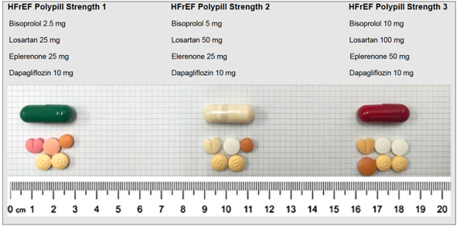
The pilot set out to answer two questions. The first was feasibility: could the sites recruit about four participants a week and carry out every step of the trial, from screening and randomization through drug dispensing, follow-up and the transition back to individual GDMT? The second was whether the polypill improved adherence to GDMT at four weeks compared with usual care, without increasing serious adverse events.
On feasibility, the sites exceeded their target. Between January and May 2025, they enrolled an average of 6.7 participants a week, 165% of the goal, and 39 of 40 participants completed both follow-up visits. Patients on the polypill also stayed on therapy more reliably. All of them had enough medication on hand to cover all four drug classes at least 80% of the time, compared with three-quarters of patients in usual care, and by pill count, 85% took at least 80% of their doses compared with 47%. Both differences were significant, and polypill patients achieved them while taking home about a third as many pills. No one in either group left the study because of an adverse event, and there were no treatment-related serious adverse events.
In an accompanying editorial, the study is highlighted as the first multicenter, randomized implementation trial of an HFrEF polypill in a low- or middle-income country, and one that shows a four-drug polypill can be delivered and reliably taken within routine public-sector care. The editorial writers concluded: “Whether the approach ultimately reduces death and durable morbidity will determine whether it becomes a fixture of global heart failure care. On the strength of these findings, that question is well worth pursuing.”
The next phase is designed to answer exactly that question. The larger, type I hybrid randomized controlled trial (NCT07569640) will test whether the polypill reduces cardiovascular death and recurrent heart failure hospitalization. The pilot shaped its design as well. Every pilot participant stayed on the lowest strength, so the larger trial uses a structured titration algorithm toward the full-strength dose. Follow-up will last a minimum of 12 months for every patient, unless consent is withdrawn, and because women made up only 18% of pilot participants, the trial prespecifies analyses by sex.
Agarwal A, de Silva A, Agarwal M, et al. Heart failure with reduced ejection fraction polypill implementation strategy in Sri Lanka: a randomized clinical trial. JAMA Cardiology. Published online Sept. 30, 2026. doi:10.1001/jamacardio.2026.3719
Fonarow GC, McMurray JJV. A polypill strategy to close the heart failure treatment gap. JAMA Cardiology. Published online Sept. 30, 2026. doi:10.1001/jamacardio.2026.3727