Written by Sheridan Thomas
Anubha Agarwal, MD, MSc, Assistant Professor of Medicine in the Division of Cardiology and co-director of the Program in Global Cardiovascular Health, is leading a multicenter randomized controlled trial in Sri Lanka that tests whether a single capsule containing all four pillars of guideline-directed medical therapy (GDMT) can improve mortality and recurrent hospitalization rates for patients with heart failure with reduced ejection fraction (HFrEF). The trial began enrolling on Aug. 17, 2026, at 14 public hospitals across the country.
Quadruple therapy with a beta-blocker, an angiotensin receptor blocker, a mineralocorticoid receptor antagonist, and an SGLT2 inhibitor are known to reduce the risk of death and heart failure hospitalization by more than half when fully implemented and adhered to, yet few patients reach it. In low- and middle-income countries, pill burden, cost, clinical inertia, and limited capacity for the repeated visits needed to start and titrate four separate medications widens the gap. Dr. Agarwal’s solution: a fixed dose polypill.
The polypill is an over-encapsulated combination of bisoprolol, losartan, eplerenone and dapagliflozin, manufactured in three strengths. Participants randomized to the polypill follow a structured titration regimen toward Strength 3, advancing one strength per visit unless a safety threshold is reached. The comparator is usual care of individualized GDMT. The open-label, type I hybrid effectiveness-implementation trial plans to enroll 1,672 adults (≥18 years old) with a left ventricular ejection fraction of ≤40% over 18 months, with every participant completing a minimum of 12 months of follow-up. The primary outcome is a composite rate of cardiovascular death and recurrent heart failure hospitalization, adjudicated by an independent committee, and implementation outcomes will show how the strategy could be scaled in Sri Lanka’s public health system.

As of September 28, 2026, 96 patients have been screened with 64 having been randomized. The trial is registered at ClinicalTrials.gov (NCT07569640) and with the Sri Lanka Clinical Trials Registry (SLCTR/2026/017) and is funded by extramural funds by the U.S. National Heart, Lung, and Blood Institute awarded to Dr. Agarwal, with additional intramural funds from Washington University in St. Louis.
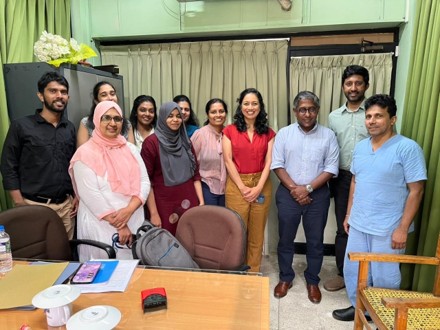
Washington University serves as the coordinating center, in partnership with the University of Kelaniya’s Faculty of Medicine, where Asita de Silva, MBBS, DPhil, is the trial’s Sri Lanka principal investigator. RemediumOne, a Colombo-based clinical research organization, leads in-country implementation, day-to-day site operations, and an independent team within the research organization conducts trial safety monitoring. The trial is governed with the expertise of an independent Steering Committee, Data Safety Monitoring Board, and Outcome Adjudication Committee.