Genetic Study Identifies Individuals Who Benefit Most From Statins
Researchers at Washington University have shown that a panel of genetic markers can identify individuals at increased risk for heart attack. Those same individuals appear to benefit most from statin therapy (read more). The research appears online March 5th in the Lancet. For patients at risk of heart disease, doctors routinely prescribe statins, known for […]
Winter 2015 WashU Alumni Newsletter (pdf) (Links to an external site)
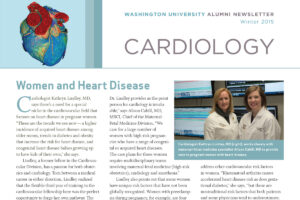
Women and Heart Disease – Cardiologist Kathryn Lindley, MD, says there’s a need for a specialniche in the cardiovascular field that focuses on heart disease in pregnant women.“These are the trends we see now — a higher incidence of acquired heart disease amongolder moms, trends in diabetes and obesity that increase the risk for heart […]
Multiple Rare Gene Mutations Associated With Increased Risk of Heart Attack
Research performed at Washington University and other leading biomedical research institutions found that multiple rare mutations in two genes increase an individual’s risk of heart attack. The research appears online this week in the journal Nature. Nathan Stitziel, MD, PhD, a cardiologist at Washington University School of Medicine and co-first author of the report, helped […]
New Treatment For Marfan’s Syndrome Shows Promise
An investigational treatment for Marfan’s syndrome is as effective as the standard therapy at slowing enlargment of the aorta, new research shows (read more). The findings indicate a second treatment option for Marfan’s patients, who are at high risk of sudden death from aortic dissection. “For years, standard medical therapy for Marfan’s syndrome consisted of […]
Gene Mutations in NPC1L1, the Target of the Drug Ezetimibe, Found to Reduce Cholesterol and Protect Against Heart Attack
Researchers at Washington University have shown that mutations in the gene NPC1L1 are associated with lower cholesterol and about 50% reduction in risk of heart attack. The research was led by Washington University Cardiologist Dr. Nathan Stitziel and appears online November 12th in the New England Journal of Medicine. Ezetimibe, a drug commonly prescribed to […]
The Heart’s Own Immune Cells Can Help It Heal
Researchers at Washington University have found the heart holds its own pool of immune cells capable of helping it heal after injury, according to a new study in mice at Washington University School of Medicine in St Louis. Research led by cardiologist Dr. Kory Levine, showed that the injured pediatric and adult heart contains two […]
New Experimental Drug Reduces Tissue Damage Following Myocardial Infarction and Minimizes the Risk of Bleeding
Researchers at Washington University and St. Louis based APT Therapeutics Inc., show that a novel drug known as APT102 significantly reduced tissue damage to heart muscle following experimental myocardial infarction and minimized the risk of bleeding during follow-up treatments. The research team at Washington University was led by Dr. Dana Abendschein. Myocardial infarction causes damage […]