Haung, X., et al. JACC 2026;87(8)1009-1025
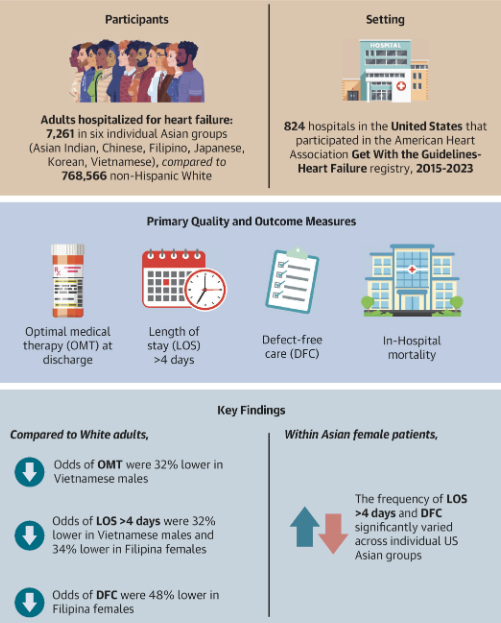
WashU Cardiovascular Division Global Health researchers have published a new article on disparity on heart failure care for Asian patients in the U.S. Mark Huffman, MD, MPH, William Bowen Endowed Professor of Medicine and Co-Director of the Global Health Center, and Anubha Agarwal, MD, MSc an associate professor of medicine and Co-Director of the Program in Global Cardiovascular Health published the research in JACC earlier this year. The study reveals that not all Asian patients receive the same quality of heart failure care in U.S. hospitals, and that lumping all Asian patients into one group can hide important differences in how well individual communities are being served.
Researchers looked at data from over 800 hospitals across the country, covering nearly a decade of heart failure hospitalizations. When aggregated as one group, Asian patients appear to be doing roughly as well as White patients. But when researchers broke data down by specific ethnic groups, the distinctions mattered a great deal.
The findings reveal real and concerning disparities in heart failure care for specific subgroups. Vietnamese male patients were less likely to receive optimal medical therapy at discharge, and Filipina female patients were significantly less likely to receive defect-free care overall. These gaps existed even though in-hospital mortality was similar across groups, suggesting the disparities reflect differences in the process and completeness of care rather than acute outcomes alone. The heterogeneity found specifically among female Asian patients across subgroups further underscores that sex and ethnicity interact in ways that aggregate analyses would completely miss.
For clinicians and hospital systems, the results point to specific populations who may benefit from more targeted discharge planning, culturally tailored education, and closer follow-up coordination. For researchers, the study makes a strong case that future work on racial and ethnic health disparities must routinely disaggregate broad pan-ethnic categories. Using aggregated “Asian” data risks masking real inequities and, worse, creating a false impression of equity.