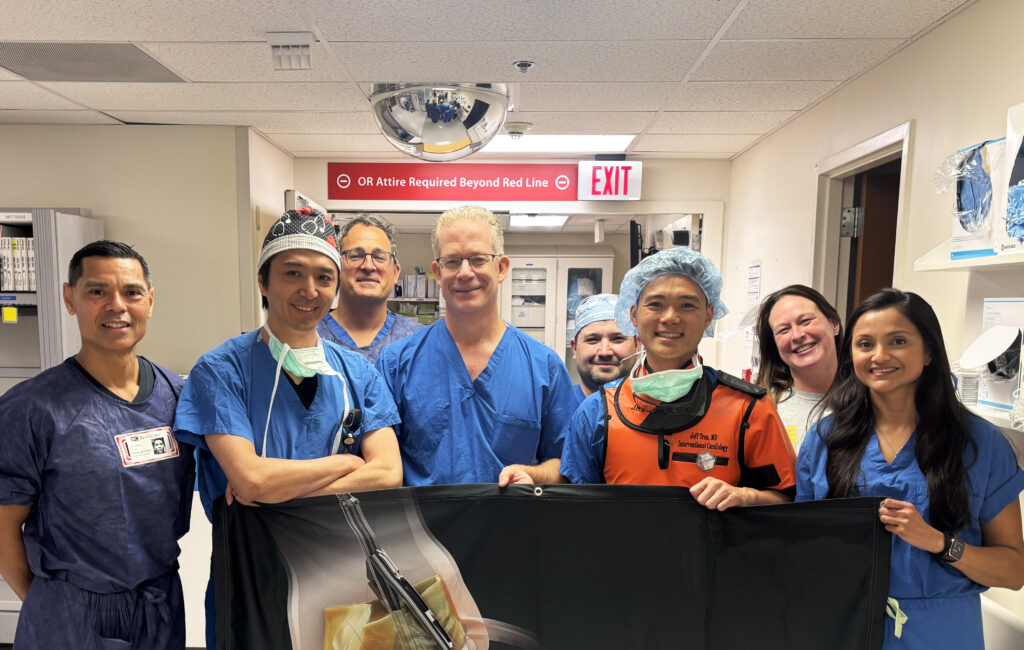
Cardiologists and cardiac surgeons from WashU Medicine’s cardiovascular and cardiothoracic surgery divisions used the used newest technology to successfully treat a high-risk patient with a failing heart valve.
Physicians at WashU Medicine have performed the first procedure in the region using a novel catheter-based tool that simplifies a complex and potentially life-saving heart valve intervention. A team including Alan Zajarias, MD, and Nishath Quader, MD, of the cardiovascular division, and Tsuyoshi Kaneko, MD, of the cardiothoracic surgery division, used the device to treat a patient who was considered too high-risk for conventional surgery. The patient was referred to WashU Medicine for the team’s expertise in leaflet modification. This is a technique for performing valve-in-valve procedures in patients at risk of a rare but serious complication known as coronary obstruction.
The world’s first dedicated leaflet modification device is designed to enable valve-in-valve transcatheter aortic valve replacement (TAVR) procedures in patients at risk of coronary obstruction. This was the first time the procedure was done at Barnes-Jewish Hospital, and was completed quickly and successfully.
The case highlights Barnes-Jewish Hospital and WashU Medicine’s standing as a regional destination for patients with complex structural heart disease. Barnes-Jewish Hospital is currently the only center within 500 miles offering this procedure using the new device for commercial implant, and is poised to draw referrals from across the region for patients whose anatomy or medical fragility places them beyond the reach of standard surgical approaches.